Live briefing

Everything about Ceramic engineering
Science and technology of creating objects from inorganic, non-metallic materials
Ceramic engineering is the science of creating objects from inorganic, non-metallic materials. This is done using either heat or precipitation reactions on high-purity chemical solutions at lower temperatures. The term includes the purification of raw materials, the study and production of chemical compounds, their formation into components, and the study of their structure, composition, and properties. Wikipedia →
🧭 Start here: a 6-step reading path
- Read the overview: Ceramic engineeringA 5-minute orientation
- Skim a recent paper: Pore size engineering of SiC ceramic membrane with pre-ceramic polymer for high retention performance and corrosion resistanceInfluential work since 2022
- Pick up a classic book: Treatise on Materials Science and TechnologyThe most-reprinted book on the subject
- Read the landmark paper: Interphase Engineering Enabled All-Ceramic Lithium BatteryCited 476 times
- Go sideways: CeramicA closely related topic
- Go sideways: Ceramic matrix compositeA closely related topic
📖 Definitions
No dictionary entry for this exact phrase.
🏆 Landmark papers (most cited)
Interphase Engineering Enabled All-Ceramic Lithium Battery
Biomorphic SiC: A New Engineering Ceramic Material
Engineering long term clinical success of advanced ceramic prostheses
Ferroelectrics: The role of ceramic science and engineering
Macroporous bioactive glass-ceramic scaffolds for tissue engineering
Chemical Engineering Aspects of Advanced Ceramic Materials
Rational Molecular Engineering of Ceramic Materials
Engineering toughening mechanisms in architectured ceramic-based bioinspired materials
🆕 Influential since 2022
Pore size engineering of SiC ceramic membrane with pre-ceramic polymer for high retention performance and corrosion resistance
Toughening of ceramics and ceramic composites through microstructure engineering: A review
Interface Engineering to Operate Reversible Protonic Ceramic Electrochemical Cells Below 500 °C
Functional layer engineering to improve performance of protonic ceramic fuel cells
Texture Engineering Modulating Electromechanical Breakdown in Multilayer Ceramic Capacitors
📚 Books worth reading
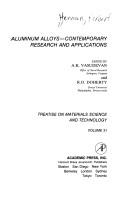 Treatise on Materials Science and TechnologyHerbert Herman · 1972
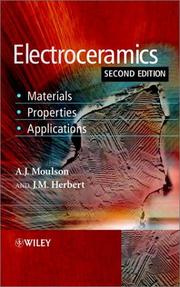 ElectroceramicsA. J. Moulson, T. Moulson · 1988
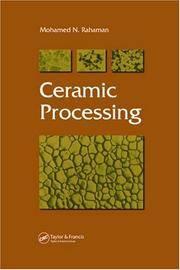 Ceramic ProcessingMohamed N. Rahaman · 2006
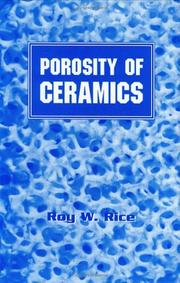 Porosity of ceramicsRoy W. Rice · 1998
 Ceramic ProcessingDebasish Sarkar · 2019
 Nanostructured CeramicsDebasish Sarkar · 2018
 Biomaterials scienceRoger Narayan, Amit Bandyopadhyay · 2011
 Advanced Ceramic Membranes and ApplicationsChandan Das, Sujoy Bose · 2017
Ranked by number of editions on Open Library, a rough measure of how lasting a book is.
🔗 Related topics
- Ceramic A ceramic is any of the various hard, brittle, heat-resistant, and corrosion-resistant materials made by shaping and then firing an inorganic, nonmetallic…
- Ceramic matrix composite In materials science ceramic matrix composites (CMCs) are a subgroup of composite materials and a subgroup of ceramics. They consist of ceramic fibers…
- Sintering Sintering or frittage is the process of compacting and forming a solid mass of material by pressure or heat without melting it to the point of liquefaction…
- Metal matrix composite In materials science, a metal matrix composite (MMC) is a composite material with fibers or particles dispersed in a metallic matrix, such as copper, aluminum…
- Toughening In materials science, toughening refers to the process of making a material more resistant to the propagation of cracks. When a crack propagates, the associated…
- Abnormal grain growth In materials science, abnormal or discontinuous grain growth, also referred to as exaggerated or secondary recrystallisation grain growth, is a grain growth…
- Solid Solid is a state of matter in which atoms are closely packed and are difficult to move past each other. Solids resist compression, expansion, or external…
- Tantalum carbide Tantalum carbides (TaC) form a family of binary chemical compounds of tantalum and carbon with the empirical formula TaCx, where x usually varies between…