Everything about Boolean algebra
Algebraic manipulation of "true" and "false"
In mathematics and mathematical logic, Boolean algebra is a branch of algebra. It differs from elementary algebra in two ways. First, the values of the variables are the truth values true and false, usually denoted by 1 and 0, whereas in elementary algebra the values of the variables are numbers. Second, Boolean algebra uses logical operators such as conjunction (and) denoted as ∧, disjunction (or) denoted as ∨, and negation (not) denoted as ¬. Elementary algebra, on the other hand, uses arithmetic operators such as addition, multiplication, subtraction, and division. Boolean algebra is therefore a formal way of describing logical operations in the same way that elementary algebra describes numerical operations. Wikipedia →
🧭 Start here: a 6-step reading path
- Read the overview: Boolean algebraA 5-minute orientation
- Skim a recent paper: MLstruct: principal type inference in a Boolean algebra of structural typesInfluential work since 2022
- Pick up a classic book: Boolean algebrasThe most-reprinted book on the subject
- Read the landmark paper: Boolean Algebras with Operators. Part ICited 581 times
- Go sideways: Boolean algebra (structure)A closely related topic
- Go sideways: Boolean algebras canonically definedA closely related topic
📖 Definitions
No dictionary entry for this exact phrase.
🏆 Landmark papers (most cited)
Boolean Algebras with Operators. Part I
Boolean Algebra and Clinical Taxonomy
Ternary Boolean algebra
The Boolean algebra of spectra
The Boolean algebra of logic
Boole's Algebra Isn't Boolean Algebra
Boolean algebra over linear polyhedra
Boolean Linear Associative Algebra
🆕 Influential since 2022
MLstruct: principal type inference in a Boolean algebra of structural types
Universal logic-in-memory cell enabling all basic Boolean algebra logic
Boolean Algebra of Soft Q-Sets in Soft Topological Spaces
Optimization Techniques and Formal Verification for the Software Design of Boolean Algebra Based Safety-Critical Systems
Output Stabilizing Control of Complex Biological Networks Based on Boolean Algebra Analysis
📚 Books worth reading
 Boolean algebrasRoman Sikorski · 1964
 Boolean algebrasRoman Sikorski · 1960
 Noise Sensitivity of Boolean Functions and PercolationChristophe Garban, Jeffrey E. Steif · 2014
 Boolean Models and Methods in Mathematics, Computer Science, and EngineeringYves Crama, Peter L. Hammer · 2010
- 📕Boolean FunctionsSerban E. Vlad · 2019
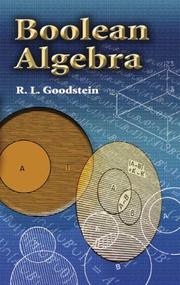 Boolean algebraR. L. Goodstein · 1963
 Boolean algebraFederal Electric Corporation. · 1966
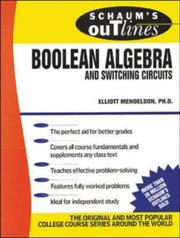 Theory and problems of Boolean algebra and switching circuitsElliott Mendelson · 1970
Ranked by number of editions on Open Library, a rough measure of how lasting a book is.
🔗 Related topics
- Boolean algebra (structure) In mathematics, a Boolean algebra or Boolean lattice is a complemented distributive lattice. This type of algebraic structure captures essential properties…
- Boolean algebras canonically defined Boolean algebras are models of the equational theory of two values; this definition is equivalent to the lattice and ring definitions. Boolean algebra…
- Heyting algebra In mathematics, a Heyting algebra (also known as pseudo-Boolean algebra) is a bounded lattice (with join and meet operations written ∨ and ∧ and with least…
- Logical connective In logic, a logical connective (also called a logical operator, sentential connective, or sentential operator) is an operator that combines or modifies…
- Outline of logic Logic is the formal science of using reason and is considered a branch of both philosophy and mathematics and to a lesser extent computer science. Logic…
- MV-algebra In abstract algebra, a branch of pure mathematics, an MV-algebra is an algebraic structure with a binary operation ⊕ {\displaystyle \oplus } , a unary…
- Disjunctive normal form In boolean logic, a disjunctive normal form (DNF) is a normal form of a logical formula consisting of a disjunction of conjunctions; it can also be described…
- Boolean function In mathematics, a Boolean function is a function whose arguments and result assume values from a two-element set (usually {true, false}, {0,1} or {−1,1})…