Live briefing
Everything about Block floating point
Method in computer arithmetic
Block floating point (BFP) is a method used to provide an arithmetic approaching floating point while using a fixed-point processor. BFP assigns a group of significands to a single exponent, rather than a single significand being assigned its own exponent. BFP can be advantageous to limit space use in hardware to perform the same functions as floating-point algorithms, by reusing the exponent; some operations over multiple values between blocks can also be done with a reduced amount of computation. Wikipedia →
🧭 Start here: a 6-step reading path
- Read the overview: Block floating pointA 5-minute orientation
- Skim a recent paper: High-Performance Acceleration of 2-D and 3-D CNNs on FPGAs Using Static Block Floating PointInfluential work since 2022
- Pick up a classic book: The C programmer's handbookThe most-reprinted book on the subject
- Read the landmark paper: High-Performance FPGA-Based CNN Accelerator With Block-Floating-Point ArithmeticCited 152 times
- Go sideways: MinifloatA closely related topic
- Go sideways: Half-precision floating-point formatA closely related topic
📖 Definitions
No dictionary entry for this exact phrase.
🗂️ The subject at a glance
🏆 Landmark papers (most cited)
High-Performance FPGA-Based CNN Accelerator With Block-Floating-Point Arithmetic
Roundoff errors in block-floating-point systems
Realization of digital filters using block-floating-point arithmetic
FlexBlock: A Flexible DNN Training Accelerator With Multi-Mode Block Floating Point Support
Realization of block floating-point digital filters and application to block implementations
A new approach for block floating-point arithmetic in recursive filters
Absolute error bounds for block floating-point direct-form digital filters
Block floating-point implementation of digital filters using the DSP56000
🆕 Influential since 2022
High-Performance Acceleration of 2-D and 3-D CNNs on FPGAs Using Static Block Floating Point
BFP-CIM: Runtime Energy-Accuracy Scalable Computing-in-Memory-Based DNN Accelerator Using Dynamic Block-Floating-Point Arithmetic
Multigrid Methods Using Block Floating Point Arithmetic
Variation-Aware Demonstration and Optimization of Block Floating Point and Integer Neural Network Acceleration on RRAM Compute in-Memory Hardware
Efficient Deep Neural Network Training With a Novel 5.3-Bit Block Floating Point Data Format
📚 Books worth reading
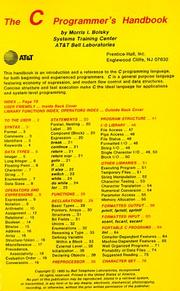 The C programmer's handbookMorris I. Bolsky · 1985
Ranked by number of editions on Open Library, a rough measure of how lasting a book is.
🔗 Related topics
- Minifloat In computing, minifloats are floating-point values represented with very few bits. This reduced precision makes them ill-suited for general-purpose numerical…
- Half-precision floating-point format Half precision (sometimes called FP16 or float16) is a binary floating-point computer number format that occupies 16 bits (two bytes in modern computers)…
- Bfloat16 floating-point format The bfloat16 (brain floating point) floating-point format is a computer number format occupying 16 bits in computer memory; it represents a wide dynamic…
- Neural processing unit A neural processing unit (NPU), also known as an AI accelerator or deep learning processor, is a class of specialized hardware accelerator or computer…
- Blackwell (microarchitecture) Blackwell is a graphics processing unit (GPU) microarchitecture developed by Nvidia as the successor to the Hopper and Ada Lovelace microarchitectures…
- Floating point operations per second Floating point operations per second (FLOPS, flops or flop/s) is a measure of computer performance or compute in computing, useful in fields of scientific…
- AMD Instinct AMD Instinct is AMD's brand of data center GPUs. It replaced AMD's FirePro S brand in 2016. Compared to the Radeon brand of mainstream consumer/gamer products…
- Extended precision Extended precision refers to floating-point number formats that provide greater precision than the basic floating-point formats. Extended-precision formats…