Everything about Autoregressive model
Representation of a type of random process
In statistics, an autoregressive (AR) model is a modelled representation of a type of random process. It can be used to describe time-varying processes from many natural and artificial sources. The model specifies output variables that are dependent linearly on their own previous values on a stochastic basis. The model is in the form of a stochastic difference equation which should not be confused with a differential equation. Together with the moving-average (MA) model, it is a special case and key component of the more general autoregressive–moving-average (ARMA) and autoregressive integrated moving average (ARIMA) models of time series, which have a more complicated stochastic structure; it is also a special case of the vector autoregressive model (VAR), which consists of a system of more than one interlocking stochastic difference equation in more than one evolving random variable. Wikipedia →
🧭 Start here: a 6-step reading path
- Read the overview: Autoregressive modelA 5-minute orientation
- Skim a recent paper: Deep Generative Modelling: A Comparative Review of VAEs, GANs, Normalizing Flows, Energy-Based and Autoregressive ModelsInfluential work since 2022
- Pick up a classic book: The Cointegrated VAR ModelThe most-reprinted book on the subject
- Read the landmark paper: Autoregressive model fitting for controlCited 303 times
- Go sideways: Autoregressive integrated moving averageA closely related topic
- Go sideways: AutocorrelationA closely related topic
📖 Definitions
No dictionary entry for this exact phrase.
🏆 Landmark papers (most cited)
Autoregressive model fitting for control
On a Mixture Autoregressive Model
Maximum entropy autoregressive conditional heteroskedasticity model
On a logistic mixture autoregressive model
A signal-dependent autoregressive channel model
Autoregressive model of 1/f noise
Independent Factor Autoregressive Conditional Density Model
Uncertain Autoregressive Model via LASSO Procedure
🆕 Influential since 2022
Deep Generative Modelling: A Comparative Review of VAEs, GANs, Normalizing Flows, Energy-Based and Autoregressive Models
Adaptive Multi-Innovation Gradient Identification Algorithms for a Controlled Autoregressive Autoregressive Moving Average Model
Reduced-Rank Envelope Vector Autoregressive Model
Two-Threshold-Variable Integer-Valued Autoregressive Model
On a matrix‐valued autoregressive model
📚 Books worth reading
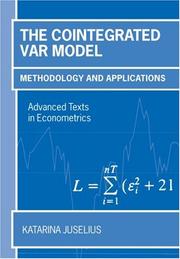 The Cointegrated VAR ModelKatarina Juselius · 2006
- 📕ARCH models for financial applicationsEvdokia Xekalaki · 2010
- 📕Commodity price shocks and the odds on fiscal performanceFrancis Y. Kumah · 2005
 ARMA model identificationByoungSeon Choi · 1992
- 📕On t he heterogeneity bias of pooled estimators in stationary VAR specificationsAlessandro Rebucci · 2003
- 📕Bayesian VARsMatteo Ciccarelli · 2003
 New directions in econometric practiceWojciech Charemza, Wojciech W. Charemza · 1991
 Likelihood-based inference in cointegrated vector autoregressive modelsSøren Johansen · 1995
Ranked by number of editions on Open Library, a rough measure of how lasting a book is.
🔗 Related topics
- Autoregressive integrated moving average In time series analysis used in statistics and econometrics, autoregressive integrated moving average (ARIMA) and seasonal ARIMA (SARIMA) models are generalizat…
- Autocorrelation Autocorrelation, sometimes known as serial correlation in the discrete time case, measures the correlation of a signal with a delayed copy of itself. Essentiall…
- Autoregressive moving-average model In the statistical analysis of time series, an autoregressive–moving-average (ARMA) model is used to represent a (weakly) stationary stochastic process…
- Stationary process In mathematics and statistics, a stationary process (also called a strict/strictly stationary process or strong/strongly stationary process) is a stochastic…
- Autocovariance In probability theory and statistics, given a stochastic process, the autocovariance is a function that gives the covariance of the process with itself…
- Autoregressive conditional heteroskedasticity In econometrics, the autoregressive conditional heteroskedasticity (ARCH) model is a statistical model for time series data that describes the variance…
- Linear prediction Linear prediction is a mathematical operation where future values of a discrete-time signal are estimated as a linear function of previous samples. In…
- Endogeneity (econometrics) In econometrics, endogeneity broadly refers to situations in which an explanatory variable is correlated with the error term. In simplest terms, endogeneity…