Everything about Atmosphere
Layer of gases surrounding an astronomical body held by gravity

An atmosphere is a layer of gases that envelop an astronomical object, held in place by the gravity of the object. The name originates from Ancient Greek ἀτμός (atmós) 'vapour, steam' and σφαῖρα (sphaîra) 'sphere'. An object acquires most of its atmosphere during its primordial epoch, either by accretion of matter or by outgassing of volatiles. The chemical interaction of the atmosphere with a solid surface can change its fundamental composition, as can photochemical interaction with the host star. A body retains an atmosphere for longer durations when the gravity is high and the temperature is low. The stellar wind works to strip away a body's outer atmosphere, although this process is slowed by a magnetosphere. The further a body is from its star, the lower the rate of atmospheric stripping. Wikipedia →
🧭 Start here: a 6-step reading path
- Read the overview: AtmosphereA 5-minute orientation
- Skim a recent paper: Microplastics and nanoplastics in the marine-atmosphere environmentInfluential work since 2022
- Pick up a classic book: The atmosphereThe most-reprinted book on the subject
- Read the landmark paper: Evolution of Organic Aerosols in the AtmosphereCited 3,774 times
- Go sideways: Comparative planetary scienceA closely related topic
- Go sideways: Extraterrestrial atmosphereA closely related topic
📖 Definitions
Noun The gases surrounding the Earth or any astronomical body.
Noun The air in a particular place.
Noun The conditions (such as music, illumination, etc.) that can influence the mood felt in an environment.
Noun The apparent mood felt in an environment.
🗂️ The subject at a glance
🏆 Landmark papers (most cited)
Evolution of Organic Aerosols in the Atmosphere
NRLMSISE‐00 empirical model of the atmosphere: Statistical comparisons and scientific issues
The rise of oxygen in Earth’s early ocean and atmosphere
Gravity wave dynamics and effects in the middle atmosphere
A dynamic global vegetation model for studies of the coupled atmosphere‐biosphere system
Extension of the MSIS Thermosphere Model into the middle and lower atmosphere
A parametric model of vertical eddy fluxes in the atmosphere
Decadal atmosphere-ocean variations in the Pacific
🆕 Influential since 2022
Microplastics and nanoplastics in the marine-atmosphere environment
Tuning the thermal activation atmosphere breaks the activity–stability trade-off of Fe–N–C oxygen reduction fuel cell catalysts
There's something in the air: A review of sources, prevalence and behaviour of microplastics in the atmosphere
Carbon-bearing Molecules in a Possible Hycean Atmosphere
Photochemically produced SO2 in the atmosphere of WASP-39b
📚 Books worth reading
 The atmosphereFrederick K. Lutgens, Edward J. Tarbuck · 1979
 Religion and chemistryJosiah Parsons Cooke Jr. · 1864
 Understanding weather and climateEdward Aguado · 1999
 Atmosphere, weather, and climateRoger Graham Barry · 1968
 Air is all around youFranklyn M. Branley, John O'Brien LL. CSS · 1962
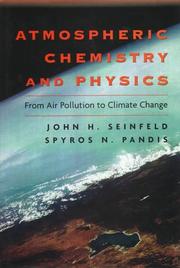 Atmospheric chemistry and physicsSeinfeld, John H., Spyros N. Pandis · 1997
 Caesar's Last BreathSam Kean · 2017
 Atmosphere, weather and climateR. G. Barry · 1968
Ranked by number of editions on Open Library, a rough measure of how lasting a book is.
🔗 Related topics
- Comparative planetary science Comparative planetary science or comparative planetology is a branch of space science and planetary science in which different natural processes and systems…
- Extraterrestrial atmosphere The study of extraterrestrial atmospheres is an active field of research, both as an aspect of astronomy and to gain insight into Earth's atmosphere. In…
- Giant planet A giant planet is a diverse type of planet much larger than Earth. It is sometimes referred to as a Jovian planet, with Jove being another name for the…
- Troposphere The troposphere is the lowest layer of the atmosphere of Earth. Pronounced /ˈtrɒpəsfɪərˌ-poʊ-/, the name comes from Ancient Greek τρόπος (trópos) 'turning…
- Hydrodynamic escape In atmospheric science, hydrodynamic escape is a thermal atmospheric escape mechanism that can lead to the escape of heavier atoms of a planetary atmosphere…
- Planetary oceanography Planetary oceanography, also called astro-oceanography or exo-oceanography, is the study of oceans on planets and moons other than Earth. This field developed…
- Atmospheric escape Atmospheric escape is the loss of planetary atmospheric gases to outer space. A number of different mechanisms can be responsible for atmospheric escape;…
- Primary atmosphere A primary atmosphere, often also called a primordial atmosphere or proto-atmosphere, is an atmosphere of a protoplanet that forms by accretion of gaseous…