Everything about Asset
Economic resource, from which future economic benefits are expected
In financial accounting, an asset is any resource owned or controlled by a business or an economic entity. It is anything that can be used to produce positive economic value. Assets represent the ownership of value that can be converted into cash . The balance sheet of a firm records the monetary value of the assets owned by that firm. It covers money and other valuables belonging to an individual or to a business. Total assets can also be called the balance sheet total. Wikipedia →
🧭 Start here: a 6-step reading path
- Read the overview: AssetA 5-minute orientation
- Skim a recent paper: Understanding Nanocellulose–Water Interactions: Turning a Detriment into an AssetInfluential work since 2022
- Pick up a classic book: Advanced financial risk managementThe most-reprinted book on the subject
- Read the landmark paper: A five-factor asset pricing modelCited 7,380 times
- Go sideways: Book valueA closely related topic
- Go sideways: Balance sheetA closely related topic
📖 Definitions
Noun A thing or quality that has value, especially one that generates cash flows.
Noun Any item recorded on the left-hand side of a balance sheet.
Noun Any component, model, process or framework of value that can be leveraged or reused.
Noun An intelligence asset.
🗂️ The subject at a glance
🏆 Landmark papers (most cited)
A five-factor asset pricing model
Conditional Heteroskedasticity in Asset Returns: A New Approach
Asset Stock Accumulation and Sustainability of Competitive Advantage
An Intertemporal Capital Asset Pricing Model
The arbitrage theory of capital asset pricing
Multifactor Explanations of Asset Pricing Anomalies
CAPITAL ASSET PRICES: A THEORY OF MARKET EQUILIBRIUM UNDER CONDITIONS OF RISK*
Multitask Principal–Agent Analyses: Incentive Contracts, Asset Ownership, and Job Design
🆕 Influential since 2022
Understanding Nanocellulose–Water Interactions: Turning a Detriment into an Asset
Deep Learning in Asset Pricing
GitHub Copilot AI pair programmer: Asset or Liability?
Open Source Cross-Sectional Asset Pricing
A Sustainable Capital Asset Pricing Model (S-CAPM): Evidence from Environmental Integration and Sin Stock Exclusion
📚 Books worth reading
 Advanced financial risk managementDonald R. van Deventer, Donald R. Van Deventer · 2004
 Managing financial institutionsMona J. Gardner, Dixie L. Mills · 1987
 The securitization markets handbookCharles Austin Stone, Anne Zissu · 2005
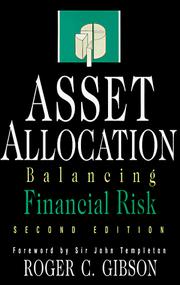 Asset allocationRoger C. Gibson · 1989
 Handbook of the economics of financeGeorge M. Constantinides, Milton Harris · 2003
 Asymmetric returnsAlexander M. Ineichen · 2006
 Portfolio designRichard C. Marston · 2011
 Stranded AssetsBen Caldecott · 2018
Ranked by number of editions on Open Library, a rough measure of how lasting a book is.
🔗 Related topics
- Book value In accounting, book value (or carrying value) is the value of an asset according to its balance sheet account balance. For assets, the value is based on…
- Balance sheet In financial accounting, a balance sheet (also known as statement of financial position or statement of financial condition) is a summary of the financial…
- Financial statement analysis Financial statement analysis (or just financial analysis) is the process of reviewing and analyzing a company's financial statements to make better economic…
- Liability (accounting) In accounting, a liability is a quantity of value that a financial entity owes. More technically, it is value that an entity is expected to deliver in…
- Fixed asset Fixed assets (also known as long-lived assets or property, plant and equipment; PP&E) is a term used in accounting for assets and property that may not…
- Financial asset A financial asset is a non-physical asset whose value is derived from a contractual claim, such as bank deposits, bonds, and participations in companies'…
- Chart of accounts A chart of accounts (COA) is a list of financial accounts and reference numbers, grouped into categories, such as assets, liabilities, equity, revenue…
- Income statement An income statement or profit and loss (P&L) account is one of the financial statements of a company and shows the company's revenues and expenses during…