Everything about Aperture
Hole or opening through which light travels

In optics, the aperture of an optical system is the hole or opening that primarily limits light propagated through the system. The aperture defines a set of rays from each point on an object that will come to a focus in the image plane. This set of rays, sometimes called a bundle of rays or cone of rays, is mathematically a generalized cone. Wikipedia →
🧭 Start here: a 6-step reading path
- Read the overview: ApertureA 5-minute orientation
- Skim a recent paper: Sparse Synthetic Aperture Radar Imaging From Compressed Sensing and Machine Learning: Theories, applications, and trendsInfluential work since 2022
- Pick up a classic book: Inverse Synthetic Aperture Radar Imaging with MATLAB AlgorithmsThe most-reprinted book on the subject
- Read the landmark paper: A tutorial on synthetic aperture radarCited 2,774 times
- Go sideways: F-numberA closely related topic
- Go sideways: Camera lensA closely related topic
📖 Definitions
Noun A small or narrow opening, gap, slit, or hole.
Noun A hole which restricts the diameter of the lightpath through one plane in an optical system. The diameter of such a hole which restricts the width of the lightpath through the whole system. For a telescope, this is the diameter of the objective lens.
Noun The diameter of such a hole which restricts the width of the lightpath through the whole system. For a telescope, this is the diameter of the objective lens.
Noun The (typically) large-diameter antenna used for receiving and transmitting radio frequency energy containing the data used in communication satellites, especially in the geostationary belt. For a comsat, this is typically a large reflective dish antenna; sometimes called an array.
🗂️ The subject at a glance
🏆 Landmark papers (most cited)
A tutorial on synthetic aperture radar
Synthetic aperture radar interferometry
Synthetic aperture radar interferometry
Focusing of high numerical aperture cylindrical-vector beams
Beaming Light from a Subwavelength Aperture
Long Optical Paths of Large Aperture
Arabidopsis OST1 Protein Kinase Mediates the Regulation of Stomatal Aperture by Abscisic Acid and Acts Upstream of Reactive Oxygen Species Production
Synthetic Aperture Radar Interferometry to Measure Earth’s Surface Topography and Its Deformation
🆕 Influential since 2022
Sparse Synthetic Aperture Radar Imaging From Compressed Sensing and Machine Learning: Theories, applications, and trends
Transport of intensity diffraction tomography with non-interferometric synthetic aperture for three-dimensional label-free microscopy
Motion Compensation/Autofocus in Airborne Synthetic Aperture Radar: A Review
Image Reconstruction With Deep CNN for Mirrored Aperture Synthesis
Synthetic Aperture Radar (SAR) for Ocean: A Review
📚 Books worth reading
 Inverse Synthetic Aperture Radar Imaging with MATLAB AlgorithmsCaner Ozdemir · 2012
 Focus on Apple ApertureCorey Hilz · 2011
- 📕Fundamentals of Aperture Antennas and ArraysTrevor S. Bird · 2015
 Apple Aperture 3Ken McMahon · 2010
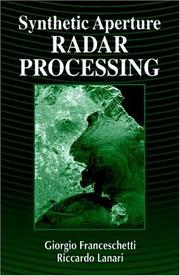 Synthetic aperture radar processingGiorgio Franceschetti · 1999
- 📕Principles of Synthetic Aperture Radar ImagingKun-Shan Chen · 2015
- 📕Synthetic aperture radar imagery of airports and surrounding areasRobert G. Onstott · 1990
 Algorithms for Synthetic Aperture Radar Imagery: ProceedingsDominick A. Giglio · 1994
Ranked by number of editions on Open Library, a rough measure of how lasting a book is.
🔗 Related topics
- F-number An f-number is a measure of the light-gathering ability of an optical system such as a camera lens. It is defined as the ratio of the system's focal length…
- Camera lens A camera lens, photographic lens or photographic objective is an optical lens or assembly of lenses (compound lens) used in conjunction with a camera body…
- Macro photography Macro photography, also called photomacrography or macrography, and sometimes macrophotography, is extreme close-up photography in which the subject is…
- Diaphragm (optics) In optics, a diaphragm is a thin opaque structure with an opening (aperture) at its center. The role of the diaphragm is to stop the passage of light,…
- Science of photography The science of photography is the use of chemistry and physics in all aspects of photography. This applies to the camera, its lenses, physical operation…
- Depth of field The depth of field (DOF) is the distance between the nearest and the farthest objects that are in acceptably sharp focus in an image captured with a camera…
- Circle of confusion In optics, a circle of confusion (CoC) is an optical spot caused by a cone of light rays from a lens not coming to a perfect focus when imaging a point…
- Stopping down In photography, stopping down refers to increasing the numerical f-stop number (for example, going from f/2 to f/4), which decreases the size (diameter)…