Live briefing

Everything about Afterload
Pressure in the wall of the left ventricle during ejection
Afterload is the pressure that the heart must work against to eject blood during systole. Afterload is proportional to the average arterial pressure. As aortic and pulmonary pressures increase, the afterload increases on the left and right ventricles respectively. Afterload changes to adapt to the continually changing demands on an animal's cardiovascular system. Afterload is proportional to mean systolic blood pressure and is measured in millimeters of mercury. Wikipedia →
🧭 Start here: a 6-step reading path
- Read the overview: AfterloadA 5-minute orientation
- Skim a recent paper: Aggressive Afterload Lowering to Improve the Right Ventricle: A New Target for Medical Therapy in Pulmonary Arterial Hypertension?Influential work since 2022
- Pick up a classic book: AfterloadingThe most-reprinted book on the subject
- Read the landmark paper: Paradoxical Low-Flow, Low-Gradient Severe Aortic Stenosis Despite Preserved Ejection Fraction Is Associated With Higher Afterload and Reduced SurvivalCited 873 times
- Go sideways: Pressure–volume loop analysis in cardiologyA closely related topic
- Go sideways: Aortic regurgitationA closely related topic
📖 Definitions
Noun The load on a working muscle from a constant opposing force
🗂️ The subject at a glance
🏆 Landmark papers (most cited)
Paradoxical Low-Flow, Low-Gradient Severe Aortic Stenosis Despite Preserved Ejection Fraction Is Associated With Higher Afterload and Reduced Survival
Afterload mismatch and preload reserve: A conceptual framework for the analysis of ventricular function
Reduced Systemic Arterial Compliance Impacts Significantly on Left Ventricular Afterload and Function in Aortic Stenosis
Prognostic significance of right ventricular afterload stress detected by echocardiography in patients with clinically suspected pulmonary embolism.
Afterload mismatch in aortic and mitral valve disease: Implications for surgical therapy
Quantification of right ventricular afterload in patients with and without pulmonary hypertension
Right Ventricular-Pulmonary Arterial Coupling and Afterload Reserve in Patients Undergoing Transcatheter Tricuspid Valve Repair
Differential Cardiac Remodeling in Preload Versus Afterload
🆕 Influential since 2022
Aggressive Afterload Lowering to Improve the Right Ventricle: A New Target for Medical Therapy in Pulmonary Arterial Hypertension?
Diagnosis and treatment of right ventricular failure secondary to acutely increased right ventricular afterload (acute cor pulmonale ): a clinical consensus statement of the Association for Acute CardioVascular Care of the European Society of Cardiology
The added value of right ventricular function normalized for afterload to improve risk stratification of patients with pulmonary arterial hypertension
Acute Afterload Mismatch After Transcatheter Tricuspid Valve Repair
Nitrosylation of cardiac CaMKII at Cys290 mediates mechanical afterload‐induced increases in Ca2+ transient and Ca2+ sparks
📚 Books worth reading
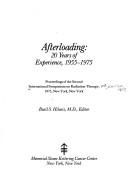 AfterloadingInternational Symposium on Radiation Therapy New York 1975. · 1975
- 📕Die ferngesteuerte Iridium-192-Afterloading-Bestrahlungsmethode [Iridium-Afterloading-Bestrahlungsmethode] zur Behandlung gynäkologischer KarzinomeJochen Maxeiner · 1987
- 📕Afterloading brachytherapy IInternational Meeting on Remote Controlled Afterloading in Cancer Treatment (1988 Wu-han shih, China) · 1990
- 📕Remote Afterloading Technology (Aapm Monography No 41) · 1992
- 📕Human factors evaluation of remote afterloading brachytherapy · 1995
- 📕Human factors evaluation of remote afterloading brachytherapy · 1995
- 📕Afterloading in radiotherapy · 1971
- 📕Dosimetry and Clinical Uses of Afterloading Systems (Report)A.R. Alderson · 1986
Ranked by number of editions on Open Library, a rough measure of how lasting a book is.
🔗 Related topics
- Pressure–volume loop analysis in cardiology A plot of a system's pressure versus volume has long been used to measure the work done by the system and its efficiency. This analysis can be applied…
- Aortic regurgitation Aortic regurgitation (AR), also known as aortic insufficiency (AI), is the leaking of the aortic valve of the heart that causes blood to flow in the reverse…
- Heart murmur Heart murmurs are unique heart sounds produced when blood flows across a heart valve or blood vessel. This occurs when turbulent blood flow creates a sound…
- Mitral regurgitation Mitral valve prolapse murmur at mitral area Heart sounds of a 16-year-old girl diagnosed with mitral valve prolapse and mitral regurgitation. Auscultating…
- Heart sounds Emily's racing heartbeat Heart sounds of a 16 year old girl immediately after running, with a heart rate of 186 BPM. The S1 heart sound is intensified…
- Heart valve Emily's heartbeat Sound of the heart valves closing in a healthy 16 year old girl. The stethoscope is at the tricuspid area. Problems playing this file…
- Valvular heart disease Mitral Valve Prolapse murmur Heart sounds of a 16-year-old girl diagnosed with mitral valve prolapse and mitral regurgitation. Auscultating her heart,…
- Outline of cardiology The following outline is provided as an overview of and topical guide to cardiology, the branch of medicine dealing with disorders of the human heart.…