Everything about .NET Remoting
Microsoft application programming interface
.NET Remoting is a Microsoft application programming interface (API) for interprocess communication released in 2002 with the 1.0 version of .NET Framework. It is one in a series of Microsoft technologies that began in 1990 with the first version of Object Linking and Embedding (OLE) for 16-bit Windows. Intermediate steps in the development of these technologies were Component Object Model (COM) released in 1993 and updated in 1995 as COM-95, Distributed Component Object Model (DCOM), released in 1997, and COM+ with its Microsoft Transaction Server (MTS), released in 2000. It is now superseded by Windows Communication Foundation (WCF), which is part of the .NET Framework 3.0. Wikipedia →
🧭 Start here: a 6-step reading path
- Read the overview: .NET RemotingA 5-minute orientation
- Pick up a classic book: Tools for atmospheric radiative transferThe most-reprinted book on the subject
- Read the landmark paper: Network Synchronization and Alarm Remoting in The DatarouteTCited 7 times
- Go sideways: Component Object ModelA closely related topic
- Go sideways: Marshalling (computer science)A closely related topic
📖 Definitions
No dictionary entry for this exact phrase.
🗂️ The subject at a glance
🏆 Landmark papers (most cited)
Network Synchronization and Alarm Remoting in The DatarouteT
Performance Comparison of ICE, HORB, CORBA and Dot NET Remoting Middleware Technologies
A Hybrid Architecture for Implementing Efficient Geospatial Web Services: Integrating .Net Remoting and Web Services Technologies
Remoting in C# and .NET.
.NET Remoting and Web Services: A Lightweight Bridge between the .NET.
Switching supports for stateful object remoting on network processors
Design and Implementation of .NET Remoting Common Framework Applied Design Pattern
Development of Distributed Remote Processing System Based on Net Remoting Technology
📚 Books worth reading
- 📕Tools for atmospheric radiative transferJeffrey R. Key · 1998
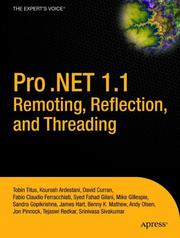 Pro .NET 1.1 Remoting, Reflection, and ThreadingDavid Curran, Fabio Claudio Ferracchiati · 2005
- 📕Searching for patterns in remote sensing image databases using neural networksJustin D. Paola · 1995
- 📕The effect of lossy image compression on image classificationJustin D. Paola · 1995
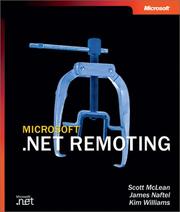 Microsoft .Net remotingScott McLean · 2003
 Distributed .NET Programming in C£Tom Barnaby · 2002
- 📕Applied information systems research program (AISRP) workshop III · 1993
 Remoting with C# and .NETDavid Conger · 2003
Ranked by number of editions on Open Library, a rough measure of how lasting a book is.
🔗 Related topics
- Component Object Model Component Object Model (COM) is a binary-interface technology for software components from Microsoft that enables using objects in a language-neutral way…
- Marshalling (computer science) In computer science, marshalling or marshaling (US spelling) is the process of transforming the memory representation of an object into a data format suitable…
- Remote Desktop Services Remote Desktop Services (RDS), known as Terminal Services in Windows Server 2008 and earlier, is one of the components of Microsoft Windows that allow…
- Windows Communication Foundation The Windows Communication Foundation (WCF), previously known as Indigo, is a free and open-source runtime and a set of APIs in the .NET Framework for building…
- Java Management Extensions Java Management Extensions (JMX) is a Java technology that supplies tools for managing and monitoring applications, system objects, devices (such as printers)…
- Remote procedure call In distributed computing, a remote procedure call (RPC) is an action in which a computer program causes a procedure (subroutine) to execute in a different…
- Distributed object communication In a distributed computing environment, distributed object communication realizes communication between distributed objects. The main role is to allow…
- Microsoft Data Access Components Microsoft Data Access Components (MDAC; also known as Windows DAC) is a framework of interrelated Microsoft technologies that allows programmers a uniform…